Navigating the 2027 ACA Updates: Affordability Rises to 10.22% as IRS Employer Mandate Penalties Increase
The Internal Revenue Service (IRS) has officially announced updated parameters for the Affordable Care Act’s (ACA) employer shared responsibility provisions for plan years beginning in 2027. The headline update is historic: for the first time since the passage of the ACA, the affordability threshold will [...]
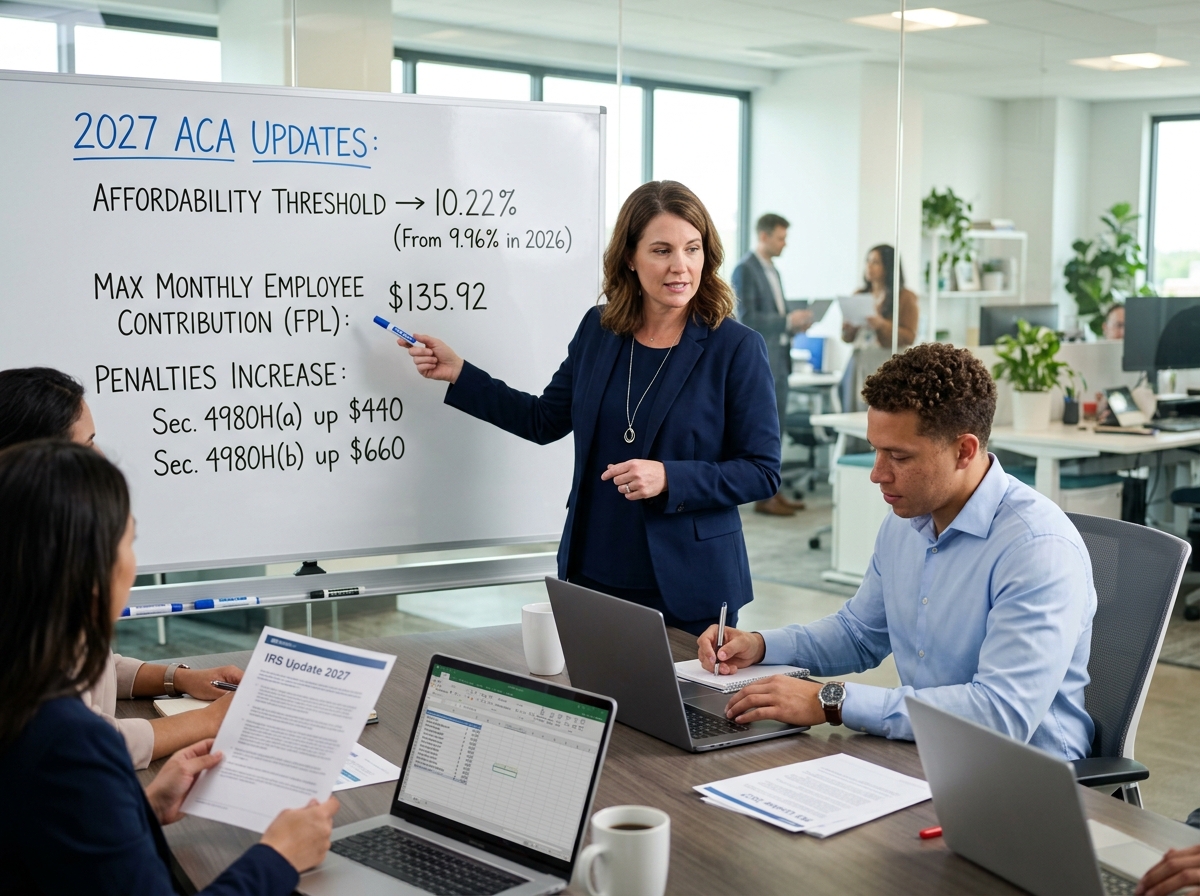



The Internal Revenue Service (IRS) has officially announced updated parameters for the Affordable Care Act’s (ACA) employer shared responsibility provisions for plan years beginning in 2027.
The headline update is historic: for the first time since the passage of the ACA, the affordability threshold will surpass 10%, rising to 10.22%. Alongside this shift, the IRS has significantly increased Section 4980H penalties for Applicable Large Employers (ALEs) that fail to offer adequate or affordable coverage.
For HR professionals, benefits administrators, and finance leaders, open enrollment prep for 2027 requires a close review of premium share strategies, safe harbor selections, and workforce count tracking.
1. The 2027 Affordability Threshold Hits a Record 10.22%
Under the ACA, employer-sponsored health coverage is considered “affordable” if the required employee contribution for the lowest-cost, self-only plan that meets minimum value does not exceed a set percentage of the employee’s household income.
For plan years beginning in 2027, that index increases to 10.22%, up from 9.96% in 2026.
2026 Affordability Cap: 9.96%
2027 Affordability Cap: 10.22%  (▲ 0.26%)
The 3 Affordability Safe Harbors
Because employers generally do not know an employee’s full household income, the IRS allows ALEs to utilize one of three safe harbor methods to demonstrate affordability:
-
Federal Poverty Line (FPL) Safe Harbor:
-
Uses the prior year’s published mainland single-person poverty guideline ($15,960 for 2026).
-
2027 Contribution Cap: $(\$15,960 \times 10.22\%) \div 12 =$ $135.92 per month for employee-only coverage. (Note: Separate guidelines apply in Alaska and Hawaii).
-
-
Rate of Pay Safe Harbor:
-
Hourly Employees: Tested as $\text{Hourly Rate} \times 130 \text{ hours} \times 10.22\%$.
-
Salaried Employees: Tested as $\text{Monthly Salary} \times 10.22\%$.
-
-
Form W-2 Safe Harbor:
-
Limits the employee’s required contribution to 10.22% of Box 1 W-2 wages for a full calendar year of coverage.
-
Employers are permitted to use different safe harbors for distinct, reasonable categories of employees (e.g., hourly vs. salaried), provided the rule is applied uniformly within each class.
2. Employer Shared Responsibility Penalties Increase for 2027
ALEs—defined as organizations employing 50 or more full-time equivalent employees (FTEs)—are subject to Section 4980H mandates. The IRS has raised penalty amounts across both parts of the mandate for 2027.
| Penalty Provision | Description | 2026 Rate | 2027 Rate | Change |
|
Section 4980H(a)
(Failure to offer coverage)
|
Assessed if an ALE fails to offer minimum essential coverage to at least 95% of full-time employees (and dependents), and at least one full-time employee receives a premium tax credit. |
$3,340/yr
($278.33/mo)
|
$3,780/yr
($315/mo)
|
+$440 per employee/yr |
|
Section 4980H(b)
(Unaffordable/Inadequate)
|
Assessed if coverage is offered, but is either unaffordable (>10.22%) or fails to provide minimum value, and an affected employee receives a premium tax credit. |
$5,010/yr
($417.50/mo)
|
$5,670/yr
($472.50/mo)
|
+$660 per employee/yr |
Note on 4980H(a) Calculations: The annualized 4980H(a) penalty applies across all full-time employees in the workforce after subtracting the first 30 employees, making non-compliance exceptionally costly for large enterprises.
3. Recommended Action Plan for Employers
To ensure compliance and mitigate tax exposure ahead of the 2027 plan year, employers should execute the following operational steps:
-
Reevaluate Employee Premium Contributions: Model your lowest-cost, self-only coverage option against the 10.22% cap. Higher threshold limits give employers room to shift employee contribution limits upward slightly without triggering affordability penalties.
-
Audit and Document Safe Harbor Methods: Review whether your current safe harbor choice (FPL, Rate of Pay, or W-2) remains optimal. Document the choice clearly for each job category to defend against potential IRS Letter 226-J assessments.
-
Review Benefit Tier Structures: If worker contributions under current pricing models breach the 10.22% threshold, evaluate raising employer subsidies or altering plan tiers before finalizing open enrollment materials.
-
Maintain Strict ALE & Hours Tracking: Continuously monitor variable-hour employees and overall headcount. Ensure systems reliably verify that offers of coverage reach at least 95% of eligible full-time staff and their dependents.
Key Takeaway
While the rise to 10.22% offers employers slightly more flexibility when pricing employee-only plan contributions, the increased Section 4980H penalty rates make non-compliance errors more expensive than ever. Early cross-functional collaboration between HR, Payroll, and Legal is critical to setting compliant benefit structures for 2027.